

Introduction
Canada requires import permits and clear product classification for pet chews. This guide explains CFIA import permits, AIRS classification, testing, country rules, and special steps for Himalayan yak/cow chews from Nepal.
Key Takeaways
- CFIA controls pet chew imports under the Health of Animals Regulations.
- AIRS classifies chews by composition, species, and tissue (bone vs. non-bone).
- Import permits are usually required (apply via My CFIA, Form CFIA/ACIA 5859).
- Microbial testing (5 samples per lot for Salmonella and Enterobacteriaceae) has been mandatory since May 2, 2022.
- Bone chews are only allowed in CFIA-recognized countries; Nepal is not recognized for them.
- Annex 1 updates require stamped pages, separate ingredient lists, and attestations (effective June 20, 2024).
CFIA’s role and why compliance matters
- The Canadian Food Inspection Agency (CFIA) guards animals, people, and trade.
- Pet chews with animal ingredients can carry disease. So rules exist to reduce risk.
- Importers who follow rules avoid delays, rejections, and costs. Who wants extra fees or lost shipments?
What are CFIA import permits and AIRS classification?
- An import permit authorizes commercial shipments of animal products and by-products to Canada. You apply online through My CFIA using Form CFIA/ACIA 5859.
- AIRS (Automated Import Reference System) is CFIA’s tool that lists requirements by product, country, and use. It tells you if a permit is needed.
- AIRS classifies dog chews by composition and origin. It looks at species (bovine, porcine, etc.), tissue type (bone vs. non-bone), and processing.
- The legal basis is the Health of Animals Act and Health of Animals Regulations.
When is an import permit required?
- Most commercial pet chew imports require a permit.
- Exceptions exist only if the relevant AIRS line says “Permit—Not required.” Always verify AIRS first.
- Personal imports for travelers: up to 20 kg per animal may be allowed under specific U.S. origin and possession rules. Commercial is different.
How to apply for an import permit (step-by-step)

- Step 1: Check AIRS for your exact product HS code and origin.
- Step 2: Log in to My CFIA and start Form CFIA/ACIA 5859.
- Step 3: Upload product descriptions, full ingredient lists, and microbial test results tied to lot numbers.
- Step 4: Wait. Typical processing is up to 30 days. Plan ahead.
- Tip: Use AIRS as a pre-check to avoid applying when not needed.
Table: Permit fee types (2025 CAD)
| Permit Type | Fee (CAD) |
| Single-use import permit | $41.99 |
| Multiple-use import permit | $71.96 |
| Risk assessment—single use | $1,199.43 |
| Risk assessment—multiple use | $1,499.28 |
| Permit amendment (minor) | $23.99 |
| Permit amendment (major) | $131.94 |
Note: Additional fees may apply for inspections, quarantine, or document review.
How AIRS classifies dog chews (detailed)
AIRS uses Chapters 5 and 23 for many chew products. Here’s a simple breakdown.
Table: AIRS chew types
| Type | AIRS Chapter | Core idea | Examples |
| Simple pet chews (by-products only) | 05/23 | The product is solely made from animal by-products. No added meat or meat meal. | Pizzles, ears, yak/cow-milk cheese sticks |
| Compound chews | 23 | Combine by-products with meat or meat meal, rawhide, and meat. | Hoof stuffed with meat meal |
| Bone chews | 05 | Made of bone. Country eligibility applies. | Smoked bones, marrow bones |
- Classification depends on species of origin (bovine, porcine, etc.), tissue type (bone vs. non-bone), and processing method.
Microbial testing and documentation rules (since May 2, 2022)
- All pet chews must pass microbiological checks. Why? Salmonella risks affect both pets and people.
- Testing protocol: 5 random samples per lot or shipment, tested for Salmonella and Enterobacteriaceae.
- Test reports must be linked to lot numbers and included in import paperwork. CFIA inspects documentation and may refuse lots lacking proper test linkage.
- This rule applies to most chews, including Himalayan yak/cow chews.
Health certificates and the documentation package
What you usually need:
- CFIA import permit (if AIRS requires it).
- A veterinary health sanitary certificate from the country of origin. For shipments originating from the U.S., a zoosanitary export certificate from USDA-APHIS is required, along with the relevant shipping documents (transition changes apply; see below).
- Product labels or ingredient lists that match the invoice and health certificate.
- Microbial test results tied to specific lots.
- Commercial invoice, packing list, bill of lading, or airway bill referencing the same lot numbers.
- Quarantine notification is sent to the CFIA quarantine station before arrival.
Annex 1 facility questionnaire—new rules (effective June 20, 2024)
- CFIA updated Annex 1 to tighten facility-level checks. There is a 12-month transition period. Key changes:
- Every page of Annex 1 must be stamped by the official veterinarian who reviewed the file.
- Two ingredient lists are required: a master list for the facility and a product-specific list for items exported to Canada.
- The official veterinarian must attest that segregation and cleaning protocols are effective.
Why does this matter?
CFIA wants proof the facility can keep Canadian-bound products separate and clean. This helps avoid cross-contamination.
Country eligibility and bone chews (2024 list)
- Only countries with CFIA-recognized veterinary systems and certifications can import bone-containing chews. As of 2024, recognized countries include:
- Asia: Japan, South Korea
- Europe: EU countries, UK, Norway, Switzerland, Iceland
- North America: United States, Mexico
- Oceania: Australia, New Zealand
- Nepal is not on this list. What does that mean for Nepal-based suppliers? Bone chews from Nepal will likely be refused. Non-bone simple chews will be considered after a risk assessment.
Alternatives and risk assessments for non-recognized countries
- If your country is not recognized, you can ask for a case-by-case evaluation. CFIA may require:
- Facility questionnaires, including Annex 1.
- On-site inspection of the foreign establishment.
- Evidence of HACCP or equivalent quality management.
- Low-risk animal products or by-products may have a smoother pathway than bone products.
Import process checklist (practical)
- Please verify the AIRS entry for your product and origin.
- If needed, apply for a permit via My CFIA (Form CFIA/ACIA 5859).
- Prepare documentation: health certificate, labels, commercial invoice, packing list, and microbial test results (5 samples/lot).
- Notify the quarantine station before shipment arrival.
- Ship through a designated port of entry.
- Expect CFIA physical inspection, sampling, and possible quarantine.
- CBSA clears goods and assigns tariff codes. Keep records for audits.
Importer’s Statement of Compliance transition (U.S. shipments)
As of January 21, 2025, the Importer’s Statement of Compliance is no longer required for U.S. shipments. Instead:
- Each shipment must include a shipping document (invoice, bill of lading, manifest, or Canada Customs Invoice) plus a USDA-APHIS zoosanitary export certificate. The shipping document must reference the certificate number.
- There is a transition for acceptance of old statements until April 21, 2025. After that date, only the new documentation will be accepted.
Packaging, storage, and transport rules
- Industry best practice for yak/cow-milk chews:
- Temperature: 15–25°C (59–77°F).
- Relative humidity: 40–50%.
- For shipments ≥5,000 kg, use refrigerated containers.
- Air freight is an option for small or urgent lots.
- Packaging should protect against contamination and physical damage. Aim for FDA-compatible packaging and clear labeling.
Labeling requirements
- Retail products must have bilingual labels (English and French). Labels should show:
- Product identity.
- The label should display the net quantity in metric units.
- The dealer’s name and address should also be provided.
- Ingredient list (descending by weight).
- Guaranteed analysis (nutrients).
- Country of origin, where applicable.
- Rawhide chews must clearly show rawhide as the animal-origin ingredient.
Himalayan yak/cow chews from Nepal—specifics and compliance steps
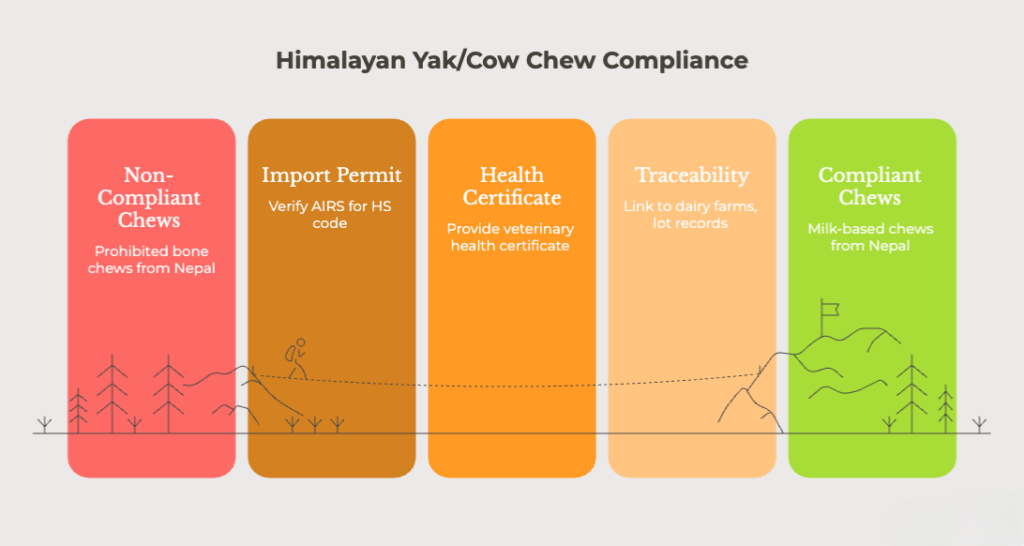
- Typical ingredients: yak milk, cow milk, lime juice, and salt. Simple and mostly from milk.
- If the product originates from Nepal, bone chews are prohibited unless Nepal receives official recognition. But milk-based simple chews can be evaluated.
- Required steps for Nepal suppliers:
- Apply for an import permit and verify AIRS for the specific HS code.
- Please provide a veterinary health certificate and Annex 1 in the new format.
- Provide traceability to dairy farms and lot-level records. CFIA may ask for farm-level documentation.
- Submit microbial test results (5 samples per lot) showing Salmonella/Enterobacteriaceae results linked to lot numbers.
- Maintain HACCP or an equivalent quality plan and show segregation and cleaning attestations.
Practical challenges for Nepal-based suppliers and how to address them
Main barriers:
- Nepal is not recognized for bone chew exports. This blocks bone product entry.
- CFIA can demand detailed traceability and on-site facility checks.
- Mandatory 5-sample Salmonella testing for every lot can increase cost.
Recommendations:
- Focus on simple non-bone chews (milk-based bars) to improve chances.
- Please develop a comprehensive HACCP-style system and ensure it is thoroughly documented.
- Prepare Annex 1 with all pages stamped by the official veterinarian.
- Budget for testing and for potential CFIA evaluations.
- Please consider working with Canadian import consultants or contacting the CFIA early to request a case-by-case risk assessment.
Contacts and online tools
- CFIA import team: APABPImport@inspection.gc.ca
- Use AIRS to confirm product rules before applying.
- Use My CFIA portal to submit permits and track applications.
- For more detail on making chews in Nepal, production, and product examples, see Lekali’s pages on production and products:
- Lekali dog chew production process: https://www.dogchewnepal.com/the-production-process/
- Lekali dog chew products (dog chew bars): https://www.dogchewnepal.com/products/dog-chew-bars/
- The origins of Lekali dog chew: https://www.dogchewnepal.com/the-origins-of-lekali-dog-chew/
Final checklist for importers (one-page)
- [ ] Check AIRS for the HS code and origin.
- [ ] Confirm whether a permit is required.
- [ ] Prepare Annex 1 (new format) and get all pages stamped by official vet.
- [ ] Implement HACCP or its equivalent.
- [ ] Run microbial tests: 5 random samples per lot; link reports to lot numbers.
- [ ] Apply through My CFIA (Form CFIA/ACIA 5859).
- [ ] Prepare health certificates, labels, invoices, packing lists, and shipping documents.
- [ ] Notify the quarantine station before arriving.
- [ ] Ship through the designated port and expect a CFIA inspection.
- [ ] Keep records for audits.
Conclusion
Follow AIRS, obtain permits via My CFIA, run the 5-sample microbial tests, and meet Annex 1 and labeling rules. Nepal suppliers should focus on non-bone milk chews, build traceability, and work with CFIA early to clear hurdles.
Resources and links
- CFIA Import Team: APABPImport@inspection.gc.ca
- AIRS and My CFIA portal (search on CFIA site)
- Lekali production process and product info:


